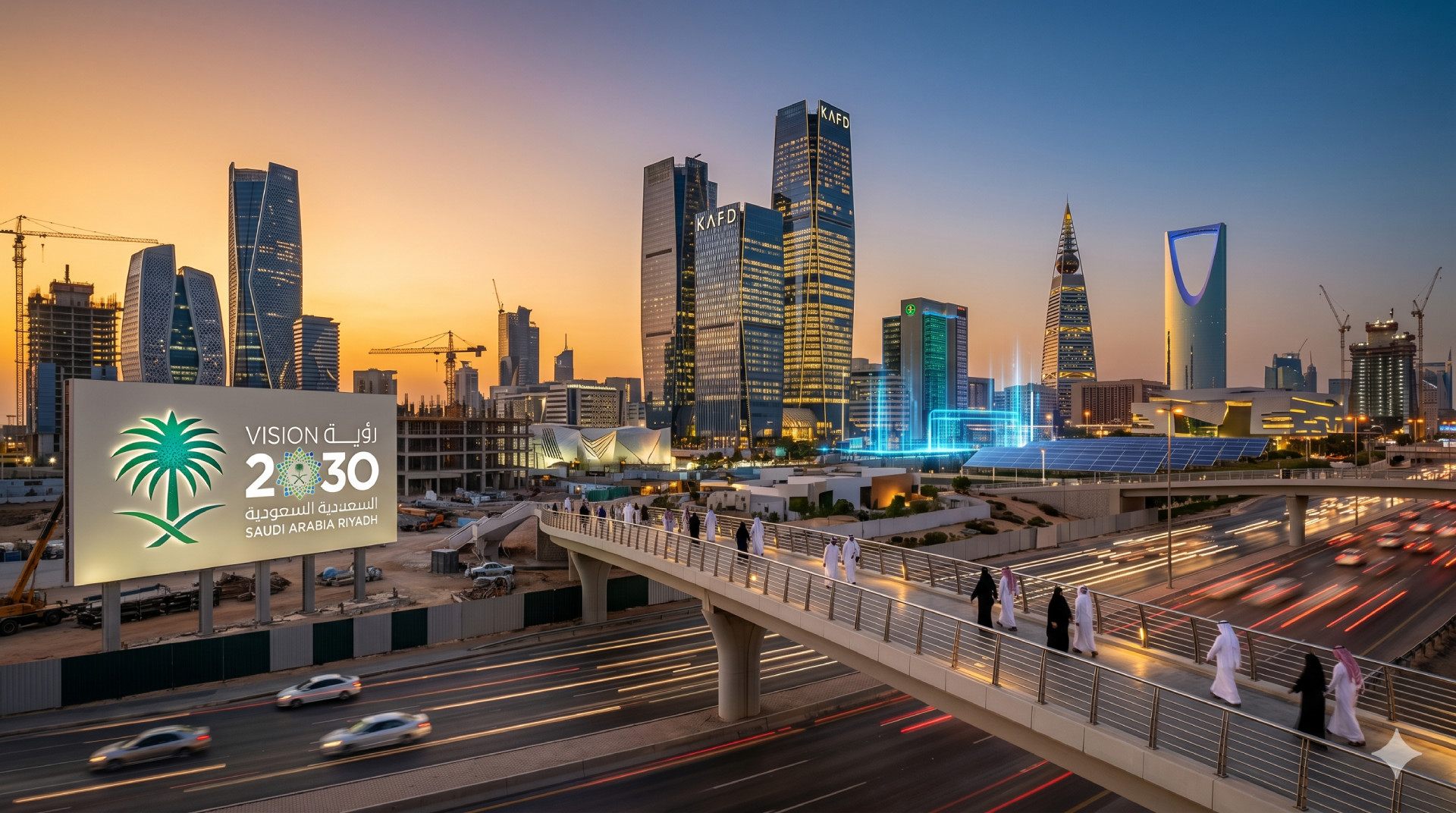
Saudi Arabia’s Vision 2030 has unlocked investment opportunities across the economy, but seven sectors stand out for foreign investors in 2026: tourism and hospitality, renewable energy and green hydrogen, technology and AI, healthcare, logistics and supply chain, financial services and fintech, and entertainment and culture. Each sector benefits from substantial government investment, regulatory reform, and demand growth — and each suits specific investor profiles. This guide explains where the money is being deployed, where the regulatory winds are blowing, what entry models work, and how to size opportunity honestly for your specific business.
Key takeaways
- Saudi Arabia is deploying over USD 1 trillion in Vision 2030 transformation across the economy
- Tourism, renewables, technology, healthcare, logistics, fintech, and entertainment lead in opportunity
- Each sector has distinct giga-projects, regulators, and entry pathways
- Saudi presence matters — most major opportunities favor entities based in the Kingdom
- Honorable mentions (mining, education, ESG, real estate) also offer significant opportunity
- The right sector for you depends on your capability, capital, and risk profile — not just sector growth
Why Saudi Arabia, why now
The scale of Vision 2030 transformation is hard to overstate. Initiated in 2016 and progressively deepened, Vision 2030 is the most ambitious national transformation program in modern Middle East history. The committed investment exceeds USD 1 trillion across:
- Giga-projects (NEOM, Red Sea, AlUla, Diriyah, Qiddiya, Roshn, and others)
- Sector reforms (tourism, entertainment, mining, healthcare, education)
- Regulatory transformation (foreign ownership, business climate)
- Workforce localization (Saudization)
- Infrastructure modernization (transport, digital, energy)
- Sovereign capability building (PIF as transformative national investor)
The combined effect creates structural demand growth in specific sectors over a 10-15 year horizon — and the foreign businesses that align with this demand are positioned to capture meaningful market share.
The seven sectors below are where the most concentrated opportunity sits.
Sector 1 — Tourism and Hospitality
Tourism is the single most transformed sector under Vision 2030. A sector that barely existed for international visitors a decade ago has become a national priority backed by giga-project investment, regulatory reform, and active promotion.
Market size and growth
Saudi Arabia is targeting hundreds of millions of cumulative visitor arrivals across the Vision 2030 horizon. The economic impact targets tourism contributing significantly to GDP, employment, and exports.
Major projects
- NEOM — The USD 500B+ megaproject in northwest Saudi Arabia, with multiple sub-projects (THE LINE, Trojena, Sindalah, Oxagon) creating tourism, residential, and commercial opportunities
- Red Sea Project — Premium destination development on the Red Sea coast, with multiple resort islands
- AlUla — Heritage tourism around UNESCO-listed historic sites, with carefully curated hospitality and cultural development
- Diriyah — Heritage and cultural tourism near Riyadh
- Qiddiya — Entertainment, sports, and lifestyle destination near Riyadh
- Soudah Peaks — Mountain tourism in Asir
- Religious tourism expansion — Holy cities infrastructure expansion supporting Hajj and Umrah growth
Entry models for foreign investors
- Hotel and resort operations — International brands operating Saudi assets through management contracts or direct ownership
- Tour operations and travel agencies — With Ministry of Tourism licensing
- Hospitality services — F&B, attractions, experiences supporting hotel ecosystems
- Tourism technology — Booking platforms, traveltech, destination management systems
- Supply chains — Hotel supplies, F&B distribution, equipment
Regulatory layer
- Ministry of Tourism — Sector regulator
- Tourism Development Fund — Investment partner for qualifying projects
- MISA — Foreign investment licensing
- Municipality — Operational permits
Best for
International hospitality brands, experienced operators, tourism technology firms, and supply chain providers willing to commit to the long-term Saudi tourism build-out.
Sector 2 — Renewable Energy and Green Hydrogen
Saudi Arabia is making one of the most ambitious clean-energy transitions of any major economy. From oil-export superpower to renewable-energy and green-hydrogen exporter — the strategic pivot is real and well-funded.
Market size and ambition
Saudi Arabia is targeting 50% of electricity generation from renewables by 2030 (with the balance from natural gas), down from the historic near-total reliance on oil and gas. The infrastructure investment is on the scale of hundreds of billions of dollars.
Major opportunities
- Utility-scale solar and wind projects — Saudi solar irradiance is among the world’s best; major projects continue to be tendered
- Green hydrogen production — NEOM’s green hydrogen facility (one of the largest globally), and other planned developments
- Battery storage and grid infrastructure
- Electric vehicle ecosystem — Manufacturing (including the Lucid plant), charging infrastructure, and supply chains
- Energy efficiency and sustainability services
- Carbon capture and circular carbon economy initiatives
Regulatory layer
- REPDO (Renewable Energy Project Development Office) — Project tendering
- Ministry of Energy — Sector policy
- Saudi Electricity Company (SEC) — Off-taker for many projects
- MISA — Foreign investment
Best for
Major IPP developers, EPC contractors, renewable technology suppliers, hydrogen technology firms, energy services firms, and the broader sustainability supply chain.
Sector 3 — Technology and AI
Saudi Arabia is building one of the most well-funded national technology ecosystems globally — with sovereign-led investment, dedicated regulatory bodies, and a Vision 2030 commitment to digital transformation across the economy.
Market drivers
- SDAIA (Saudi Data and AI Authority) — Driving national AI strategy with concrete initiatives
- Cloud Computing SEZ — Dedicated zone for hyperscale cloud infrastructure
- Smart city deployments — NEOM, Riyadh smart city initiatives, others
- Government digital transformation — Massive ongoing program across ministries and services
- Private sector digitization — Across financial services, healthcare, retail, logistics
- Public Investment Fund (PIF) tech investments — Significant capital across the tech ecosystem
Specific opportunities
- Cloud services — Hyperscale cloud, regional cloud, data center operations
- AI and machine learning — Both enterprise AI services and AI infrastructure
- Cybersecurity — Especially critical infrastructure protection
- Enterprise software — ERP, HRIS, vertical applications
- Fintech (covered separately in Sector 6)
- Edtech, healthtech, regtech — Vertical applications
- Telecommunications infrastructure and services
Regulatory layer
- SDAIA — AI and data policy
- CITC (Communications, Space, and Technology Commission) — Telecom and digital infrastructure
- MISA — Foreign investment
- NCA (National Cybersecurity Authority) — Cybersecurity standards
Best for
International technology firms with proven enterprise capabilities, cloud providers, AI specialists, cybersecurity firms, vertical software companies, and the broader tech services ecosystem.
Sector 4 — Healthcare
Healthcare is undergoing structural transformation as the Saudi system shifts from a state-dominated model toward broader private-sector participation, insurance-funded delivery, and quality-driven competition.
Market drivers
- Health Sector Transformation Program — Major restructuring of public healthcare delivery
- Private sector expansion — Encouraging investment in private hospitals, clinics, diagnostics
- Insurance market growth — Cooperative Health Insurance (CHI) framework expanding mandatory coverage
- Demographic factors — Growing, increasingly health-conscious population
- Medical tourism ambitions — Growing inbound medical tourism
- Pharmaceutical localization — Manufacturing localization initiatives
- Healthcare technology — Telehealth, digital health, AI in healthcare
Specific opportunities
- Hospital and specialty center development
- Outpatient clinics and chains
- Diagnostic and laboratory services
- Medical device distribution and manufacturing
- Pharmaceutical distribution and manufacturing
- Healthcare IT and digital health
- Insurance and managed care services
- Medical education and training
Regulatory layer
- Ministry of Health (MOH) — Sector policy and facility licensing
- Saudi Commission for Health Specialties (SCFHS) — Medical professional licensing
- Saudi Food and Drug Authority (SFDA) — Drugs and medical devices
- Council of Health Insurance (CHI) — Health insurance regulation
- MISA — Foreign investment
Best for
International hospital operators, specialty healthcare firms, medical device companies, pharmaceutical firms, healthtech innovators, and healthcare services providers committed to building genuine Saudi presence.
Sector 5 — Logistics and Supply Chain
Saudi Arabia’s strategic positioning between Asia, Europe, and Africa, combined with massive infrastructure investment, is repositioning the Kingdom as a regional logistics hub.
Market drivers
- Geographic positioning — On the Red Sea trade route between Asia and Europe
- Port expansion — King Abdullah Port (KAEC), Jeddah Islamic Port, Dammam, and others
- Special Integrated Logistics Zone (SILZ) — Major logistics-focused SEZ at Riyadh airport
- Rail expansion — Saudi Landbridge and other rail infrastructure
- Air cargo capacity — Riyadh airport and KAUST cargo capabilities
- E-commerce growth — Domestic e-commerce driving last-mile demand
- Manufacturing localization — Driving inbound logistics for component supply
- Pilgrim logistics — Religious tourism creating substantial logistics demand
Specific opportunities
- Freight forwarding and 3PL — International freight, customs brokerage, contract logistics
- Warehousing and distribution — Greenfield and brownfield warehouse development
- Last-mile and e-commerce fulfillment
- Cold chain and specialized logistics
- Port and terminal operations
- Maritime services — Bunkering, ship agency, marine services
- Air cargo and express services
- Logistics technology — TMS, WMS, visibility platforms
Regulatory layer
- Ministry of Transport and Logistic Services — Sector policy
- Saudi Ports Authority (MAWANI) — Port operations
- Saudi Railways (SAR) — Rail
- GACA — Civil aviation including cargo
- Customs (under ZATCA) — Trade flows
- MISA — Foreign investment
Best for
International freight forwarders, 3PL providers, port operators, e-commerce logistics specialists, cold chain operators, and logistics technology firms.
Sector 6 — Financial Services and Fintech
Saudi Arabia’s financial sector is among the most mature in the Middle East, with sophisticated banking, growing capital markets, and an active regulatory framework supporting fintech innovation.
Market drivers
- SAMA (Saudi Central Bank) — Active regulator supporting innovation including the Regulatory Sandbox
- CMA (Capital Market Authority) — Capital markets regulator; Tadawul is the largest GCC stock exchange
- PIF and sovereign wealth — Massive capital deployment shaping the financial landscape
- Insurance market growth — Health, life, motor, and broader insurance growth
- Banking sector consolidation — Major bank mergers creating regional-scale players
- Fintech expansion — Digital banking, payments, BNPL, embedded finance
- Islamic finance leadership — Saudi Arabia hosts among the world’s largest Islamic finance institutions
- Wealth management growth — Domestic wealth management market expansion
Specific opportunities
- Digital banking and neobanks
- Payment services — Acquiring, issuing, payment infrastructure
- BNPL (Buy Now Pay Later)
- Embedded finance — APIs for non-financial businesses to embed financial services
- WealthTech and robo-advisory
- InsurTech
- RegTech — Compliance and regulatory technology
- Capital markets infrastructure — Trading, post-trade, custody
- Asset management — Both conventional and Islamic
- Reinsurance and specialty insurance
Regulatory layer
- SAMA — Banking, payments, insurance, fintech
- CMA — Capital markets, asset management, specific fintech categories
- Tadawul — Stock exchange
- MISA — Foreign investment
Best for
Financial technology firms, payment companies, digital banking platforms, wealthtech and insurtech innovators, and international financial services firms with proven track records willing to work within the SAMA/CMA framework.
Sector 7 — Entertainment and Culture
A sector that barely existed for international participation a decade ago is now one of the most dynamic in the Saudi economy. Cinema, music, sports, gaming, theme parks, festivals, and broader entertainment have become real, scalable opportunities.
Market drivers
- General Entertainment Authority (GEA) — Sector regulator and active programmer
- MDLBeast and major music events — Including Soundstorm
- Saudi Tourism Authority (STA) — Linked tourism-entertainment crossover
- Qiddiya — Massive entertainment-destination megaproject
- Major sports investments — Football (Saudi Pro League), motorsport (F1, Dakar Rally), boxing, golf (LIV), MMA, esports
- Cinema and content — Cinemas operating since 2018; significant content production growth
- Cultural events — Riyadh Season, Jeddah Season, and others
- Gaming and esports — Major national focus including major investments
Specific opportunities
- Entertainment venue operations
- Event management and production
- Content production — Film, TV, digital, music
- Live entertainment — Concerts, festivals, performances
- Cinema operations
- Gaming and esports — Development, broadcasting, venues
- Sports management and events
- Theme park and attraction operations
- Entertainment technology
Regulatory layer
- General Entertainment Authority (GEA) — Sector regulation and licensing
- Ministry of Sport — Sports activities
- General Authority for Audiovisual Media (GCAM) — Media regulation
- Ministry of Culture — Cultural sector
- MISA — Foreign investment
Best for
International entertainment operators, content producers, event management firms, sports management companies, gaming and esports firms, and theme park operators committed to engaging with the Saudi market opportunity.
Honorable mentions — significant additional opportunities
Beyond the seven primary sectors, four additional sectors deserve recognition:
Mining
Saudi Arabia is investing in becoming a global mining hub, leveraging substantial underdeveloped mineral resources. Ma’aden is the national mining champion, but the sector is opening to broader investment. Opportunities include exploration, extraction, processing, and the supporting services ecosystem. The Mining Investment Law and supporting regulations have been progressively reformed.
Education
Education reform is creating substantial opportunity for international education operators, edtech, training, and professional development firms. International school expansion, higher education partnerships, vocational training (with TVTC), and edtech for both K-12 and corporate learning markets are growing.
ESG and sustainability services
ESG-focused services — sustainability consulting, carbon accounting, ESG reporting, green building, sustainable supply chain — are growing as Saudi corporates and PIF-portfolio companies expand sustainability commitments. This sector cuts across all others and is genuinely growing.
Real estate
Real estate development, property management, brokerage, and adjacent services are growing on the back of demographic factors, urbanization, and giga-project demand. Real estate sees activity through ROSHN, NHC, NEOM, Diriyah, and many other developers. Foreign property ownership rights have expanded under Vision 2030 reforms.
Picking the right sector for you
Not every sector fits every investor. Five questions to help you focus:
- What’s your existing capability?
The strongest entries come from genuine sector expertise. A pharmaceutical company should evaluate healthcare; a tech company should evaluate the Saudi tech opportunity; a logistics firm should look at logistics. Stay close to what you actually know.
- What’s your capital and risk profile?
- Mega-project participation requires substantial capital and patience
- Service businesses can enter with modest capital
- Capital-intensive sectors (energy, healthcare, manufacturing) suit specific investor profiles
- Tech and services suit nimble entrants
- What’s your time horizon?
Vision 2030 is a 10-15 year transformation. Quick wins exist, but the deepest returns come from sustained Saudi commitment. If you’re testing the market for 12 months, choose accordingly.
- What’s your government-sector orientation?
Some sectors (healthcare, defense, infrastructure, certain technology, mining) have substantial government and sovereign-related opportunity. Others (entertainment, F&B, tourism) skew more private-sector. Match your sector choice to your commercial model.
- Are you committed to genuine Saudi substance?
The biggest opportunities flow to businesses with genuine Saudi presence — Saudization, local leadership, real office, real workforce. Sectors that require deep substance suit committed investors; sectors that tolerate lighter presence suit different profiles.
Frequently Asked Questions
What’s the most profitable sector for foreign investors in Saudi Arabia?
There’s no single answer — the most profitable sector depends on your capabilities and capital. For tech-enabled firms, the technology sector offers the largest opportunity. For experienced operators, hospitality and tourism are deeply attractive. For specialized players, renewable energy and healthcare offer substantial margins. Match the sector to your genuine competitive advantages.
Which Saudi sector is growing fastest in 2026?
Tourism and entertainment are experiencing the steepest growth from a low base — these sectors barely existed for international participation a decade ago. Technology and renewable energy are growing rapidly off substantial bases. Healthcare is growing structurally with demographic and policy tailwinds. Most sectors aligned with Vision 2030 priorities are seeing materially above-trend growth.
What is Vision 2030?
Vision 2030 is Saudi Arabia’s national transformation program launched in 2016 under Crown Prince Mohammed bin Salman, designed to diversify the economy away from oil dependency, modernize the society, and reposition Saudi Arabia as a regional and global leader across multiple sectors. The program has committed over USD 1 trillion in investment and has driven structural reform across regulation, business climate, tourism, entertainment, and broader social and economic life.
Should I invest in NEOM?
NEOM is one of the world’s largest megaprojects, but direct investment in NEOM is selective — typically through specific tenders, supply contracts, partnerships, or participation in NEOM-anchored zones (like NEOM’s green hydrogen ecosystem). For most foreign investors, the right NEOM-related strategy is participating in the demand NEOM creates (supply contracts, services, technology) rather than seeking direct NEOM equity participation.
Can foreigners invest in Saudi sports and entertainment?
Yes — sports and entertainment are open to foreign investment with 100% foreign ownership permitted in most activities through MISA licensing. The General Entertainment Authority (GEA), Ministry of Sport, and General Authority for Audiovisual Media (GCAM) coordinate sector regulation. Major international sports management firms, content producers, entertainment operators, and event management firms have established Saudi operations.
What sectors are getting Saudi government investment?
Across Vision 2030, government and PIF investment spans many sectors — particularly tourism, renewable energy, technology, healthcare, mining, infrastructure, entertainment, sports, and manufacturing. PIF’s investment portfolio gives a public view of priority sectors. Major giga-projects (NEOM, Red Sea, AlUla, Diriyah, Qiddiya, Roshn) anchor sector-specific investment cascades.
How does the RHQ program affect sector investment?
The RHQ program creates structural incentive for multinationals to consolidate regional management in Saudi Arabia, with 30-year tax exemption and increasing eligibility for Saudi government procurement. For multinationals across sectors, the RHQ becomes the regional management layer — operating activities still sit in separate operating entities, but the RHQ status enables broader competitive positioning. See our RHQ guide.
Are smaller foreign businesses welcome in Saudi Arabia?
Yes — Saudi Arabia explicitly welcomes SMEs and smaller foreign investors, with the entrepreneurial license category, Monsha’at (the small business authority) support, and broader Vision 2030 commitment to building a diverse business ecosystem. Service sectors in particular are accessible to smaller foreign investors. The Saudi opportunity is not exclusively for mega-multinationals.
About Register in KSA. We help foreign investors identify and capture the Vision 2030 opportunity across all major Saudi sectors — combining strategic sector advisory with end-to-end execution: MISA licensing, sector regulator coordination, banking, tax, HR, and ongoing compliance. Book a strategic consultation to discuss your Saudi sector strategy.