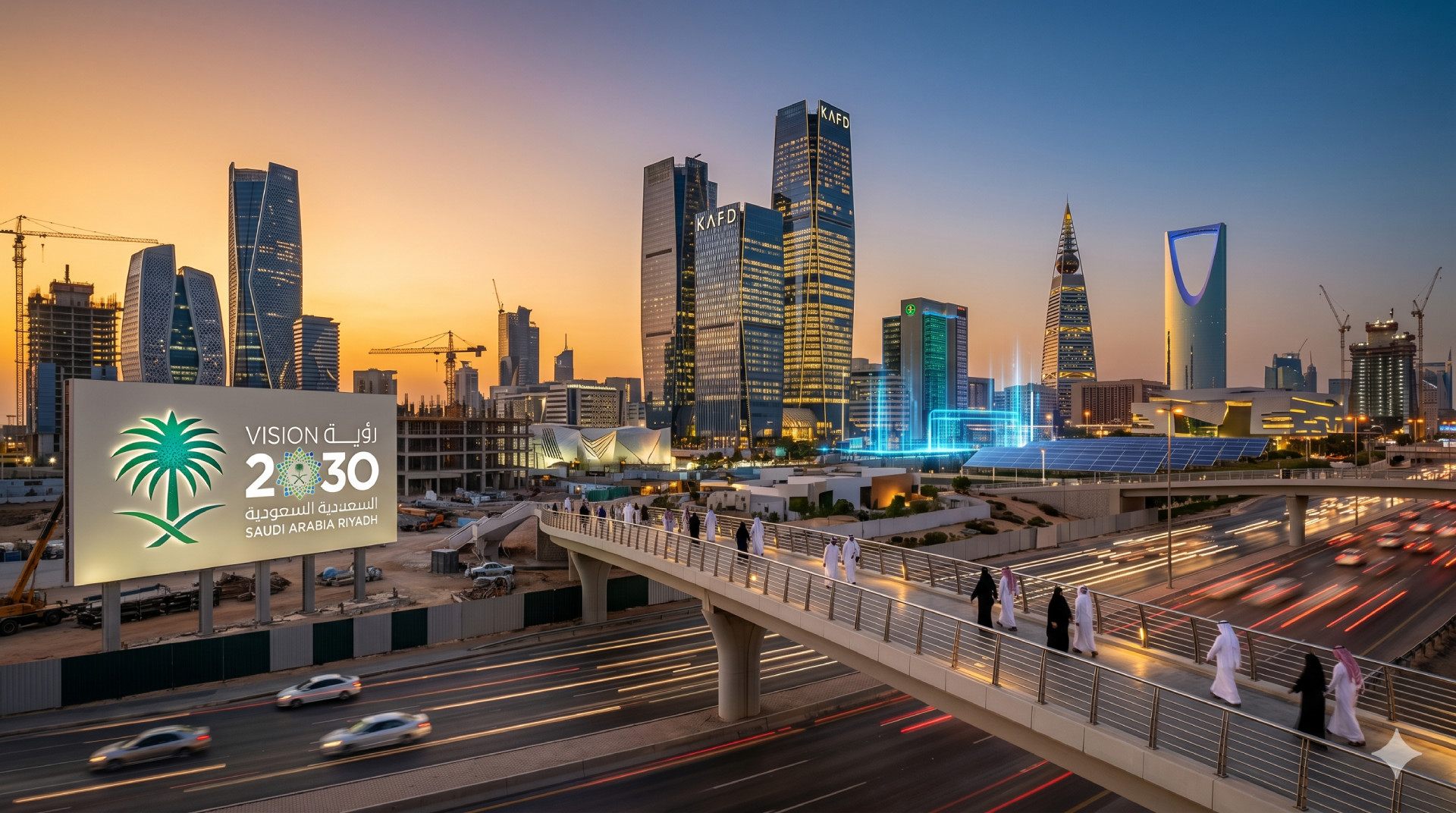
Saudi Arabia’s Special Economic Zones (SEZs) offer foreign investors major tax and regulatory incentives in defined geographic areas. The four primary SEZs launched in 2023 are the Special Integrated Logistics Zone (SILZ) at Riyadh airport, King Abdullah Economic City (KAEC) on the Red Sea, the Cloud Computing SEZ, and Riyadh Integrated. Each targets specific industries — logistics, manufacturing, cloud and data infrastructure, and advanced manufacturing respectively — with incentives including reduced corporate tax, customs exemptions, streamlined licensing, and zone-specific regulatory frameworks. This guide explains each zone, when SEZ-based setup wins over mainland setup, and how Saudi’s framework compares to UAE free zones.
Key takeaways
- Saudi Arabia launched four primary SEZs in 2023: SILZ, KAEC, Cloud Computing SEZ, and Riyadh Integrated
- SEZs offer major incentives: reduced corporate tax (5% on qualifying activities for 20 years in some configurations), customs exemptions, regulatory flexibility
- SILZ at Riyadh airport offers 50-year corporate tax exemption on qualifying logistics activities
- NEOM is technically a separate framework — not strictly an “SEZ” but offering its own incentives
- SEZ vs mainland is a strategic decision, not always SEZ-better — depends on activity, market, customers
- Saudi SEZs are newer than UAE free zones but rapidly maturing
Why Saudi Arabia’s SEZ framework matters
For years, foreign investors weighing the GCC considered Saudi Arabia’s “lack of free zones” a structural disadvantage versus the UAE’s 40+ established free zones. That has changed.
Saudi Arabia launched its modern SEZ framework formally in 2023 with the announcement of four primary SEZs, each strategically positioned for specific sectors. The framework was designed not as a generic free-zone-style framework but as purpose-built industrial zones with targeted incentives for strategic sectors aligned with Vision 2030.
The SEZs sit alongside other specialized economic structures — most notably NEOM (which operates under its own framework) and the established industrial cities under MODON. Together, they create a multi-tier economic-zone landscape that genuinely offers options for foreign investors.
What the SEZ framework offers
While specific incentives vary by zone, the general SEZ proposition typically includes:
- Reduced or zero corporate income tax on qualifying activities (for defined periods)
- Customs duty exemptions on imports for qualifying activities
- Streamlined licensing through zone authorities
- Sector-specific regulatory frameworks suited to zone activities
- 100% foreign ownership (consistent with mainland reforms)
- Repatriation of profits without restriction
- Strategic infrastructure purpose-built for the zone’s focus sectors
The combination of incentives and infrastructure for qualifying activities can be transformative.
SILZ — Special Integrated Logistics Zone
Location: Riyadh, at King Khalid International Airport
Sector focus: Logistics, re-export, light manufacturing, MRO, value-added activities
Regulator: Economic Cities and Special Zones Authority (ECZA)
The Special Integrated Logistics Zone (SILZ) is Saudi Arabia’s flagship logistics SEZ, strategically positioned at Riyadh’s main airport with direct integration to cargo facilities, customs processes, and the broader Saudi logistics infrastructure.
What SILZ offers
- 50-year corporate income tax exemption on qualifying logistics and re-export activities — one of the longest-duration incentives globally
- Customs duty exemptions on imports for qualifying uses
- Zero VAT on intra-zone activities and many qualifying transactions
- Streamlined customs and immigration through ECZA’s integrated framework
- Sector-specific licensing suited to logistics operations
- Strategic location at Riyadh airport with direct cargo access
Qualifying activities
- Re-export operations — Goods imported to SILZ and re-exported with value-added processing
- Maintenance, repair, and overhaul (MRO)
- Light assembly and processing
- Logistics services — Cross-docking, distribution, contract logistics
- Value-added activities — Repackaging, labeling, quality control
- Hub operations — Regional distribution from Riyadh
Best for
- International logistics companies establishing regional hubs
- E-commerce fulfillment operators
- MRO operators serving GCC aviation
- Manufacturers using Saudi Arabia as a re-export platform
- Value-added logistics operators
Setup considerations
SILZ setup runs through ECZA, with sector-specific licensing aligned to the zone’s framework. The 50-year tax exemption is a powerful incentive but applies to qualifying activities — activities outside the qualifying scope are taxed normally. Structure operations to maximize qualifying-activity treatment.
KAEC — King Abdullah Economic City
Location: Red Sea coast, ~100km north of Jeddah
Sector focus: Port-anchored logistics, manufacturing, services
Regulator: ECZA + KAEC-specific framework
King Abdullah Economic City (KAEC) is one of the most established economic city developments in Saudi Arabia. While its development trajectory has evolved over the years, KAEC has matured into a substantive economic city with established companies, infrastructure, and the King Abdullah Port — one of the Kingdom’s strategic Red Sea ports.
What KAEC offers
- Reduced corporate income tax on qualifying activities (specific rates and durations per the KAEC SEZ framework)
- Customs exemptions on imports for qualifying uses
- Strategic port access — King Abdullah Port is operational and connecting to global shipping routes
- Manufacturing-ready infrastructure — Industrial parks with utilities, logistics, and connectivity
- Residential and lifestyle infrastructure — KAEC is a city, not just an industrial zone
- Logistics integration — Port-anchored value chain potential
Anchor companies
KAEC has progressively attracted established operators across multiple sectors — including pharmaceutical manufacturing (Mars, Sanofi pharmaceutical operations), automotive components, light industrial, and consumer goods. The presence of established anchors creates an ecosystem effect that benefits new entrants.
Qualifying activities
KAEC’s SEZ framework supports a broader range of activities than SILZ’s logistics focus, including:
- Light manufacturing and assembly
- Pharmaceutical manufacturing
- Consumer goods production
- Port-anchored logistics
- Services supporting industrial operations
- Other qualifying activities per the framework
Best for
- International manufacturers seeking Saudi production base with port access
- Pharmaceutical and life sciences operations
- Consumer goods producers serving Saudi and broader GCC markets
- Logistics operators leveraging port connectivity
- Service providers supporting the KAEC ecosystem
Setup considerations
KAEC setup integrates with both ECZA’s SEZ framework and the established KAEC city infrastructure. The combination of incentives, port access, and mature industrial infrastructure makes KAEC attractive for capital-intensive manufacturing investments with regional market orientation.
Cloud Computing SEZ
Location: Across Saudi Arabia (zone status is framework-based, not single-location)
Sector focus: Cloud infrastructure, data centers, AI compute
Regulator: ECZA with SDAIA/CITC coordination
The Cloud Computing SEZ is Saudi Arabia’s purpose-built framework for hyperscale cloud infrastructure, data center operations, and the broader cloud and AI compute ecosystem. It addresses the strategic priority of building Saudi’s national data and AI capabilities.
What the Cloud Computing SEZ offers
- Reduced corporate income tax on qualifying cloud activities for defined periods
- Customs and import-duty incentives on data center equipment
- Streamlined approvals for cloud and data infrastructure
- Coordination with SDAIA for AI and data initiatives
- Coordination with CITC for telecommunications and infrastructure
- Data residency support — Saudi data residency for regulated workloads
Qualifying activities
- Hyperscale cloud infrastructure operations
- Data center construction and operation
- Cloud services — IaaS, PaaS, SaaS at scale
- AI compute and ML training infrastructure
- Edge computing infrastructure
Best for
- Hyperscale cloud providers (the major global cloud platforms)
- Data center operators
- AI compute infrastructure providers
- Edge computing specialists
Setup considerations
Cloud Computing SEZ status is granted on a framework basis to qualifying operations, rather than tied to a specific physical zone location. Companies must meet the qualifying criteria and operate within the framework’s scope. The SEZ is designed to support both Saudi market workloads and regional/global workloads served from Saudi infrastructure.
Riyadh Integrated SEZ
Location: Riyadh
Sector focus: Advanced manufacturing, aerospace, defense, medical technology, electric vehicles
Regulator: ECZA
Riyadh Integrated is Saudi Arabia’s SEZ focused on advanced manufacturing and strategic industries. It supports the Vision 2030 priority of building Saudi capability in high-value manufacturing sectors.
What Riyadh Integrated offers
- Reduced corporate income tax on qualifying advanced manufacturing activities
- Customs exemptions on imported inputs for qualifying production
- Streamlined licensing for advanced manufacturing
- Infrastructure support for sector-specific operations
- Coordination with Ministry of Industry and Mineral Resources (MIM) and sector regulators
Qualifying activities
- Aerospace and defense components manufacturing
- Medical device manufacturing
- Electric vehicle and component production
- Advanced electronics
- Other strategic high-value manufacturing
Best for
- International advanced manufacturing firms
- Aerospace and defense suppliers
- Medical technology manufacturers
- EV ecosystem participants
- Advanced electronics producers
Setup considerations
Riyadh Integrated supports the strategic objective of building Saudi capability in high-value manufacturing. Qualifying activities benefit from substantial incentives. Operations must align with the zone’s advanced-manufacturing focus to qualify.
NEOM — a different beast
NEOM is not strictly a SEZ in the same framework as SILZ, KAEC, Cloud Computing SEZ, and Riyadh Integrated. NEOM operates under its own governance and regulatory framework as Saudi Arabia’s flagship megaproject, with planned subprojects including:
- THE LINE — A 170km linear city
- Trojena — Mountain tourism and ski destination
- Sindalah — Luxury island destination
- Oxagon — Industrial and innovation hub
- NEOM Green Hydrogen — One of the world’s largest green hydrogen facilities
NEOM’s incentive framework is designed around the megaproject’s strategic priorities. For specific NEOM investment opportunities — supply contracts, partnership arrangements, anchor investments — the NEOM framework applies.
For most foreign investors, NEOM-related strategy is participating in the demand NEOM creates (supplying NEOM, partnering on NEOM contracts) rather than seeking direct NEOM-zone investment. Where direct NEOM investment is appropriate, the NEOM framework provides its own structural pathway.
Other significant zones
Jazan Economic City (JEC)
Jazan, in southwestern Saudi Arabia, hosts an economic city focused on heavy industry, energy-related activities, and adjacent operations. JEC has specific incentive frameworks aligned with its strategic positioning.
Knowledge Economic City (KEC) — Madinah
Knowledge Economic City in Madinah has a focus on knowledge-economy activities — education, healthcare, technology, and related sectors with appropriate framework considerations for the Madinah location.
MODON industrial cities
MODON (the Saudi Authority for Industrial Cities and Technology Zones) operates a network of established industrial cities across Saudi Arabia. These are not SEZs in the new framework sense but offer ready-to-use industrial infrastructure with utilities, roads, and logistics for foreign manufacturing investments. MODON cities are well-established across Riyadh, Jeddah, Dammam, and other strategic locations.
Other emerging zones
The Saudi SEZ framework is expected to expand over time with additional zones being added as strategic sectors and regions are prioritized.
How SEZ incentives actually work
Three things to understand about Saudi SEZ incentives:
- Incentives are activity-specific
The major incentives — reduced corporate tax, customs exemptions, regulatory streamlining — apply to qualifying activities within the zone’s defined scope. Activities outside the qualifying scope are taxed normally.
Companies operating in SEZs need to structure activities to maximize qualifying-activity treatment. A SILZ tenant doing both qualifying logistics activities and non-qualifying activities effectively has two tax regimes operating in parallel.
- Substance matters
SEZ incentives, like the RHQ tax exemption, are designed around genuine substance. Companies claiming SEZ benefits must actually operate the qualifying activities within the zone, with appropriate substance — real operations, real employees, real activities.
- The incentives are real but require careful structuring
For activities that genuinely fit a zone’s focus, the incentives are transformative. SILZ’s 50-year tax exemption on qualifying logistics activities, for instance, can fundamentally reshape the economics of regional logistics hub operations.
But the structuring required to realize the incentives is non-trivial. Engage with specialists who understand SEZ frameworks and their interaction with broader tax structure.
SEZ vs mainland — when each wins
The question for many foreign investors is: should I set up in a SEZ or in the mainland?
SEZ wins when:
- Your activities clearly fit the zone’s qualifying scope — SILZ for logistics and re-export, KAEC for manufacturing with port linkage, Cloud Computing for hyperscale cloud, Riyadh Integrated for advanced manufacturing
- Tax economics are material to your business model — Long-duration tax incentives compound significantly
- You can commit to real substance in the zone
- Your operating model is largely activity-self-contained — Doesn’t require constant integration with broader mainland operations
- Customs exemptions matter — Particularly for re-export operations and qualifying imports
Mainland wins when:
- Your customers are mainland Saudi customers — Selling into the Saudi mainland from a SEZ can carry VAT and customs implications that erode the benefits
- Your activities don’t fit zone scopes — Most services, consulting, and general commercial activities are mainland-natural
- Government and procurement engagement is core — Mainland status often fits public-sector engagement better
- Operational integration with mainland Saudi operations is significant
- The SEZ incentives don’t materially affect your model
- RHQ status is the appropriate structure — RHQs operate within their own framework
A common pattern
Many foreign investors with multiple Saudi activities use both: a mainland entity for general operations and customer-facing activities, with a SEZ entity for specific qualifying activities (logistics, manufacturing, cloud). This creates structural complexity but can be the right answer for sophisticated operations.
How to set up in a Saudi SEZ
Setup in a Saudi SEZ generally follows a similar broad pattern to mainland setup, with zone-specific elements:
Step 1 — Engagement with the zone authority — Pre-application engagement with ECZA or the zone-specific authority to scope your operations and confirm qualifying-activity treatment
Step 2 — Strategic structuring — Activity scope, qualifying-activity design, substance plan, financial model considering the SEZ incentives
Step 3 — Zone application — Application through the zone authority’s framework
Step 4 — MISA license — Foreign investment license (often coordinated with the zone framework)
Step 5 — Articles, CR, Chamber — Standard incorporation steps adapted to zone framework
Step 6 — Sector regulator engagement — Where applicable (SDAIA, MIM, etc.)
Step 7 — Office, infrastructure, banking — Zone-based setup
Step 8 — Operational launch with SEZ status active
Setup timelines for SEZ entities can be efficient because of the zone authority’s streamlined frameworks, but are activity-specific. Engage early to scope timelines for your specific case.
How Saudi SEZs compare to UAE free zones
For investors familiar with UAE free zones, key differences:
| Dimension | Saudi SEZs | UAE free zones |
| Framework maturity | Newer (2023 formal launch) | Established (decades) |
| Sector focus | Strategic industrial/logistics/tech | Broad — every conceivable sector |
| Number of zones | 4 primary SEZs + NEOM + others | 40+ free zones |
| Tax incentives | Variable; SILZ 50-year exemption notable | Various structures with effective low tax |
| Selling to mainland | Complex — mainland sale considerations | Long-established mainland-vs-freezone distinction |
| Market access | Saudi Arabia (much larger market) | UAE + regional positioning |
| Substance expectations | Substance-based incentives | Substance increasingly required (post-OECD) |
| Regulatory framework | Activity-aligned | Generally activity-flexible |
The Saudi framework is more strategically targeted — built around specific Vision 2030 priorities — while the UAE framework is broader and more established for general business setup.
For most decisions, the question isn’t “Saudi SEZ vs UAE free zone” — it’s “Saudi or UAE for my business” (see our comparison guide), and then within the chosen jurisdiction, “mainland or zone.”
Frequently Asked Questions
Does Saudi Arabia have free zones like Dubai?
Saudi Arabia has Special Economic Zones (SEZs) that offer significant incentives, customs exemptions, and tax benefits — broadly comparable in function to UAE free zones, though structured around Saudi’s strategic sectors rather than generic free-zone activity. The four primary SEZs launched in 2023 (SILZ, KAEC, Cloud Computing, Riyadh Integrated) plus NEOM and established zones provide multiple options. The framework is newer than UAE’s but rapidly maturing.
How long do SEZ tax exemptions last?
Duration varies by zone and activity. SILZ offers a 50-year corporate income tax exemption on qualifying logistics and re-export activities — one of the longest-duration incentives globally. Other zones have their own durations. RHQ status (separately) offers 30 years. The specific exemption applicable to your activity should be verified with the zone authority and qualified advisors.
Can I do business outside the SEZ from inside it?
Doing business between the SEZ and the Saudi mainland is structurally important. Sales to mainland customers typically involve VAT and potentially customs treatment depending on the goods/services and zone-specific rules. Activity within the SEZ enjoys the SEZ incentives; activity crossing into the mainland may face mainland tax and customs treatment. Structure operations accordingly.
What’s the difference between SEZs and MODON industrial cities?
SEZs offer fiscal and regulatory incentives (reduced tax, customs exemptions, sector-specific licensing). MODON industrial cities provide established industrial infrastructure — utilities, roads, logistics, services — but operate under mainland tax and regulatory rules. MODON suits foreign manufacturers wanting ready-to-use industrial infrastructure; SEZs suit operations that genuinely qualify for the SEZ incentive framework. They serve different purposes and aren’t substitutes.
Is NEOM the same as the other SEZs?
No — NEOM operates under its own framework, separate from the SEZ framework that covers SILZ, KAEC, Cloud Computing, and Riyadh Integrated. NEOM has its own governance and regulatory approach designed for the megaproject’s specific strategic priorities. For most foreign investors, the practical interaction with NEOM is through supply, partnership, or contract opportunities rather than direct NEOM-zone investment.
What’s the corporate tax rate in Saudi SEZs?
Rates vary by zone and activity. SILZ offers 50-year exemption (effectively 0%) on qualifying activities. Other SEZs have their own rates. Activities outside qualifying scopes face standard 20% corporate tax. The specific rate applicable to your activity and zone should be verified with the zone authority. SEZ status materially affects tax economics only when activities genuinely qualify.
Can I open a SEZ company entirely remotely?
Setup involves Saudi-based elements — notarization, banking verification, possibly Iqama processing for senior staff. While much of the application can be coordinated remotely through advisors, expect to visit Saudi Arabia at least once during setup. Once operational, day-to-day SEZ company operations are largely manageable digitally.
Are SEZs better than mainland setup?
Not universally — SEZs are better when your activities genuinely fit a zone’s qualifying scope and the incentives are material. For most service businesses, professional services, and customer-facing operations, mainland setup is structurally simpler and fits the business model better. For specific qualifying activities (logistics, manufacturing, cloud, advanced manufacturing), SEZs can be transformative. Match the structure to the activity, not the other way around.
About Register in KSA. We structure foreign-invested operations in Saudi Arabia’s Special Economic Zones — across SILZ, KAEC, Cloud Computing, Riyadh Integrated, NEOM-related operations, and other zone frameworks — alongside mainland operations where appropriate. Our SEZ practice combines deep zone-framework expertise with practical understanding of how SEZ operations integrate with broader Saudi market strategy. Book a strategic consultation to evaluate whether a SEZ or mainland structure is right for your Saudi business.